Landmarks Do Not Culture Make


There’s a particular kind of travel sadness that sneaks up on you slowly.
You arrive somewhere famous. The architecture is flawless. The sky behaves. The camera loves it. The landmark does its job… dramatic, iconic, postcard-ready. You take the photo. You do the respectful “wow.” And then you look around and realise you’re standing inside something that feels… hollow.
Not ruined. Not ugly. Just strangely airless.
Like the city has been staged for visitors, but the locals, the ordinary, frustrating, beautiful locals, have been quietly edited out. And that’s the uncomfortable question I want to sit with: what happens when we protect the landmarks but displace the people who make a place feel like itself?
Because here’s the thing: landmarks are not culture. They are containers. Culture is what lives inside them; the accents, the rituals, the weird little local rules, the corner shops with no website, the late-night arguments, the street music, the aunties at the markets, the artists who can’t afford “professional” but still manage to be brilliant.
Culture is people. And when you price out the people, you don’t just create a housing crisis you create a meaning crisis. You end up with cities that look incredible but feel empty. Cities that can be “experienced” but no longer lived. Cities that have become a set.
The paradox of success: when “popular” becomes predatory
Barcelona is the textbook case people keep pointing to, and for good reason. It’s one of those places that has everything: history, beauty, food, public life, late-night energy. It is, in every sense, a magnet. And yet the very thing that made it irresistible has become the weapon that hollows it out.
When a city becomes a global product, the market does what the market always does: it extracts. It looks at housing and says, “This can earn more.” It looks at neighbourhoods and says, “This can be branded.” It looks at locals and says, “They can commute.”
Barcelona’s decision to move toward ending tourist apartment licences by 2028 wasn’t a quirky political flourish, it was the sound of a city trying to pull itself back from the edge, explicitly linking short-term rentals to housing affordability and liveability. Residents protesting overtourism, not because they hate visitors, but because they’re watching the social fabric fray in real time, has become part of the public story.
This isn’t “tourists are bad.” That’s lazy. This is systems are doing what systems do when left unchecked: turning homes into inventory, communities into aesthetics, and the local economy into a kind of extraction economy - the city as content, no longer lived. And if you’ve ever found yourself walking a neighbourhood and thinking, “This feels like an Airbnb brochure,” you’ve felt it too.
The Airbnb problem isn’t only Airbnb
Let’s not pretend Airbnb invented greed. The problem is bigger than one platform. But the platform has become a symbol of something we can actually name: the conversion of residential life into a tourist commodity.
Research across multiple contexts has found that as short-term rental density rises, housing prices and rents tend to rise too, sometimes sharply, because supply is pulled out of the long-term market and redirected toward higher-yield short stays. That is not a moral statement. It’s a market statement. And markets don’t care about community memory.
Markets don’t care that a queer teenager needs a cheap inner-city share house to survive their first year out. Markets don’t care that the artist who made the neighbourhood interesting needs a studio and a sandwich. Markets don’t care that the old woman who knows everyone’s name is the difference between a street that feels safe and a street that feels like a corridor.
Markets don’t do empathy. That’s the job of civic systems. Which means: if governments and councils and business / precinct leaders don’t build guardrails, the market will eventually sell the soul of the place, one “investment opportunity” at a time.
When the landmark becomes a queue
Japan and China don’t need lessons in culture. Their cultural depth is not fragile. But they are now facing the same phenomenon many global cities face: over-tourism concentrated in specific hotspots - the same famous routes, the same iconic streets, the same “must see” list that funnels millions into a handful of places.
Kyoto has become the emblem of it. The city has moved to restrict tourist access in parts of Gion’s private alleys, not out of drama but out of necessity, a response to crowding and behaviour that made residents feel like they lived inside a theme park. And if you want the plain-language insight behind the policy shifts, it’s brutally simple: when tourism becomes too concentrated, businesses start prioritising tourists over locals because it’s more profitable and everyday life for residents becomes harder, while local identity starts to thin out.
That’s the mechanism. Not hatred. Not xenophobia. Mechanism.
If you’ve ever stood in a line for a temple, perhaps a tower, or a scenic view and felt the strange pressure of the crowd, the hurried selfie, the “move along,” the sense that nobody is there to be present, they’re there to prove they were there then you’ve felt the transformation of culture into consumption.
A landmark can survive that.
A neighbourhood spirit rarely does.
Overtourism is now widely described not just as “too many tourists,” but as the point where residents feel their quality of life and local ways of living are diminished by tourism pressure. That definition matters, because it centres the human experience, not just visitor numbers.
Sydney: when you put a rainbow sticker on a shopping mall
Now let me bring it home, because this isn’t a European problem or an Asian problem. It’s a global city problem.
Sydney has its own version of this, and in precinct work you see it up close. You see how quickly “place-making” becomes place-marketing. You see how easily a community’s identity becomes a branding opportunity.
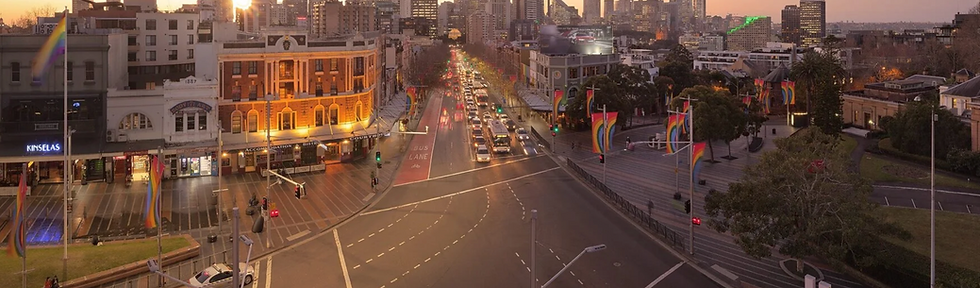
Oxford Street and the Rainbow Precinct carry genuine cultural history. That isn’t up for debate. The City of Sydney has documented and planned for the precinct as a living social and cultural place, and the heritage assessment work underlines how deep and real that social history is.
But here’s the tension that deserves honesty: You can install the world’s largest rainbow flag in a square. You can commission glossy campaigns. You can do a “Pride activation” with a DJ and a sponsor wall. And still lose the essence. Because the essence was never the flag.
It was the bohemians, the outsiders, the creatives, the broke queer kids and the older queer elders, the oddballs and night-shift humans, the small bars that didn’t care if you were polished, the community organisations that ran on grit, the bookshops and record stores and “you’ll find it upstairs” venues.
When those people can’t afford to be there, when the housing becomes short-stay accommodation, when commercial rents squeeze out the independent weird, when international brands drop their cookie-cutter model into the middle and add a rainbow sticker and call themselves “inclusive innovators” the precinct doesn’t become more vibrant. It becomes more expensive and less alive. It becomes a showroom of identity rather than a lived community.
And corporate Australia is very good at this trick: borrow the credibility of the fringe while pricing the fringe out of the room. That’s not “progress.” That’s extraction with better fonts.
The high street didn’t die. We killed it with “best use”
The story of the high street everywhere is the same: we allowed “highest and best use” to replace “human and best use.” We replaced local services with global brands. We replaced cheap creative spaces with luxury developments. We replaced everyday living with visitor spending.
And then we stood back and said, “Why does it feel soulless?” Because we removed the people who made it soulful.
It’s the same pattern in Barcelona, in Kyoto, in parts of inner Sydney, in pockets of New York and London and anywhere a neighbourhood becomes “hot.” It is the lifecycle of cool when it’s treated as a commodity:
Artists and outsiders move in because it’s affordable and permissive.
The vibe grows.
The marketing arrives.
The investors arrive.
The prices rise.
The people who made it cool can’t afford it.
The vibe becomes a memory, sold back to you as a lifestyle.
We are not watching cities “change.” We are watching cities get stripped.
What this does to us psychologically
This isn’t only economics. It’s nervous system stuff. Place is not neutral. Place holds identity. Place holds belonging.
When locals are displaced, the city becomes less relational. The social cues shift. Trust drops. People feel watched rather than known. The public realm becomes transactional rather than communal.
And even tourists feel it, though they might not have language for it. They come looking for “authenticity” and end up in a crowd of other seekers, moving through a curated experience that lacks the messy human texture they came for.
Research on place identity and tourism impacts repeatedly circles the same truth: people’s sense of belonging and community identity is shaped by how tourism changes daily life, not just by economic benefit, but by whether locals still recognise themselves in their own streets.
This is why overtourism becomes emotionally charged. It’s not just “too many people.” It’s a loss of self, experienced at street level.
So, what do we do - besides complain?
Here’s the part where I refuse to be sentimental without being practical.
If we want places to remain living cultures rather than scenic backdrops, we need to start acting like housing is civic infrastructure, not just personal wealth. We need to accept that the “free market” is not built to protect culture, it is built to maximise return.
Which means we need policy spine.
Some cities are already experimenting with hard choices: restricting or ending tourist apartment licences (Barcelona), managing tourist flows and behaviour in sensitive districts (Kyoto), raising accommodation taxes or using levies to fund infrastructure, spreading visitor load beyond a single “golden route.”
But a real response is bigger than tourism management. It includes:
Housing policy that keeps people in place: more social and affordable housing, stronger tenant protections, real enforcement against illegal short-stays, and planning that assumes locals matter more than visitor yield.
Commercial diversity protections: the ability for independent venues, community businesses, and creative spaces to exist without being crushed by speculative rent.
Precinct strategies that are culture-first, not marketing-first and a refusal to pretend a rainbow sticker is a substitute for a living queer ecosystem.
Accountability for platforms and data transparency: cities can’t manage what they can’t measure.
And yes, we need to talk about corporations too. If your brand wants to borrow the cultural credibility of a precinct, then you can also pay for the conditions that keep that culture alive. Don’t just sponsor the festival. Support the housing. Support the creative incubation. Support the community infrastructure. Otherwise, you’re not “supporting Pride,” you’re participating in displacement while posing for photos.
The core lesson
Landmarks do not culture make.
Culture is made by the people who live there long enough to build rituals.
Culture is made by the weird and the broke and the brave.
Culture is made by communities that have room to be messy, not just presentable.
If we keep displacing locals, we will end up with cities that are visually magnificent and emotionally empty, the urban equivalent of a beautiful museum with no heartbeat. And when the heartbeat goes, the landmark becomes a prop.
So, here’s the question I want to leave you with the one that should sit in every planning meeting, every tourism strategy, every precinct “revitalisation” pitch:
Are we building places for people to live… or places for people to visit?
Because if we only build places to visit, we’ll eventually lose the thing visitors came for in the first place. And no amount of glossy branding will bring it back.
References and further reading
Barcelona plan to end tourist apartment rentals by 2028 (ABC News, 21 Jun 2024). (ABC News)
Barcelona to ban apartment rentals to tourists by 2028 (The Guardian, 22 Jun 2024). (The Guardian)
Barcelona residents protest overtourism / water pistols reporting (ABC News, 16 Aug 2024; The Independent, 15 Jun 2025). (ABC News)
Franco & Santos (2021), The impact of Airbnb on residential property values and rents (Portugal evidence; Journal of Economic Geography / ScienceDirect). (ScienceDirect)
Kyoto restricting tourist access in Gion (The Guardian, 7 Mar 2024; Business Insider, 13 Mar 2024; The Straits Times, 7 Mar 2024). (The Guardian)
Japan addressing overtourism, resident impacts and business incentives (ABC News, 6 Mar 2026). (ABC News)
Conceptual definition of overtourism and social impacts (PMC paper; European Parliament study on overtourism). (PMC)
City of Sydney: Oxford Street LGBTIQA+ social and cultural place strategy (Published 24 Feb 2023). (City of Sydney)
City of Sydney: Oxford Street LGBTIQA+ Heritage Assessment Report (TKD Architects, 2 Dec 2024). (City of Sydney Meetings)
Place identity and perceived impacts of tourism on community identity (Taylor & Francis, 2024; and related place identity research). (Taylor & Francis Online)


Comments